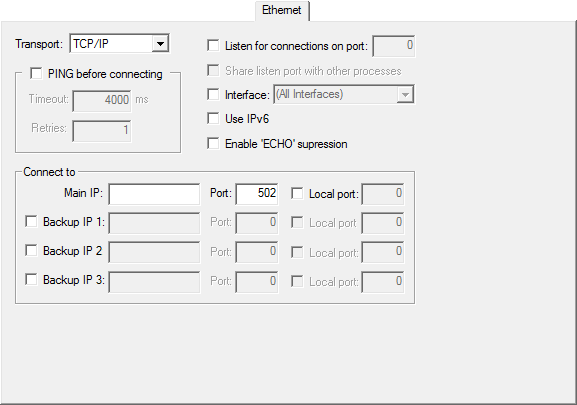
Use this tab to configure parameters of the Ethernet Interface. These parameters (all except port configurations) must also be configured for use in the RAS.
Ethernet tab
Available options on Ethernet tab
Option
Description
Transport
Select TCP/IP for a TCP socket (stream). Select UDP/IP to use a UDP socket (connectionless datagram).
Listen for connections on port
Use this option to wait for new connections in a specific IP port (common in Slave Drivers). If this option remains unselected, the Driver connects to the address and port specified in the Connect to option.
Connect to
These options configure an IP address and port of a remote device.
·IP: Type an IP address of a remote device. It can be an IP address separated by dots as well as a URL (for a URL, the Driver uses the available DNS service to map that URL to an IP address). For example, "192.168.0.13" or "Server1"
·Port: Type an IP port of a remote device (from 0 to 65535)
·Specify local port: Select this option to use a fixed local port when connecting to the main address
Backup address
Enables a backup address if a device provides an alternative IP address (if the first address fails):
·IP: Type an alternative IP address of a remote device. This can be an IP address separated by dots or a URL
·Port: Type an alternative IP port of a remote device (from 0 to 65535)
·Specify local port: Select this option to use a fixed local port when connecting to the backup address
PING before connecting
Enable this option to execute a ping command (check if a device can be reached on a network) for a device before trying a socket connection. This is a quick way of determining a successful connection before trying to open a socket with a device (the time-out of a connection with a socket can be very high):
·Timeout: Specify the number of milliseconds to wait for a reply from the ping command. Users must use the ping command to check the normal reply time, configuring this option for a value above that average. Usually this value can be configured between 1000 and 4000 milliseconds (between one and four seconds)
·Retries: Number of retries of a ping command (not counting the first attempt). If all attempts fail, then the socket connection is aborted.
Enable 'ECHO' suppression
Enable this option to remove the echo from received data. An echo is a copy of sent data, which can be returned before a reply message.